
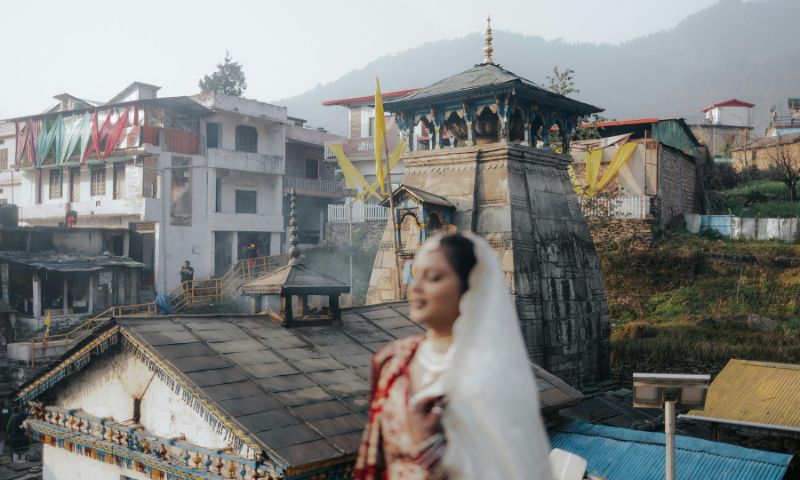
There is a temple in Uttarakhand where a fire has supposedly been burning for three yugas (ages). Not inside a lamp. Not behind glass. In an open hawan kund, right in front of the main shrine, fed by wood offerings from devotees who have been adding to it for centuries. That temple is Triyuginarayan, and the fire is believed to be the same one that witnessed the wedding of Lord Shiva and Goddess Parvati.
Located in the Rudraprayag district at an altitude of about 1,980 metres, Triyuginarayan Temple sits in a quiet village surrounded by the Garhwal Himalayas. It is roughly 12 km from Sonprayag and about 25 km from Kedarnath, yet it receives a fraction of the footfall. Most Char Dham pilgrims pass through the area without knowing it exists.
This guide covers the mythology, the architecture, the eternal flame, how to get there, what to see nearby, and why a growing number of couples are now choosing this temple as their actual wedding venue.
The Mythology Behind Triyuginarayan Temple
According to Hindu tradition, Triyuginarayan was the capital of King Himavat (the personification of the Himalayas) and the birthplace of Goddess Parvati. It is here that the celestial marriage of Lord Shiva and Goddess Parvati is said to have taken place. Lord Vishnu performed the kanyadaan (giving away the bride), Lord Brahma served as the priest, and the entire assembly of gods and celestial beings attended the ceremony.
The name itself tells the story. “Tri” means three, “Yugi” refers to yugas (cosmic ages), and “Narayan” is another name for Lord Vishnu. Together, the name suggests that Lord Vishnu has been present at this site across three cosmic ages, watching over the sacred fire that was lit at the time of the divine wedding.
The fire burning in the hawan kund in front of the temple is called Akhand Dhuni. Devotees believe it has been burning continuously since the wedding ceremony. Pilgrims add small pieces of wood to keep it going, and many carry the ash home as a sacred token of marital blessings.
Temple Architecture and Layout
The current structure of Triyuginarayan Temple is attributed to Adi Shankaracharya, who is believed to have rebuilt it during the 8th century. The architectural style closely resembles the Kedarnath and Badrinath temples, with a stone facade, a mandapa (prayer hall), and a garbhagriha (inner sanctum) housing the idol of Lord Vishnu in a standing posture.
In front of the temple sits the Akhand Dhuni, the perpetual fire pit, which is the focal point for most visitors. The temple courtyard also features three sacred ponds:
- Rudra Kund: Believed to have been created by Lord Shiva
- Vishnu Kund: Associated with Lord Vishnu
- Brahma Kund: Linked to Lord Brahma
Local belief holds that the water from these kunds has restorative properties, particularly for couples seeking marital harmony and blessings for fertility. The temple is surrounded by a small cluster of village houses, a handful of guesthouses, and terraced fields that slope toward the valley below.
Why Couples Are Choosing Triyuginarayan as a Wedding Venue
In recent years, Triyuginarayan Temple has gained attention as a real wedding destination, not just a pilgrimage site. The idea is simple but powerful: if this is the place where the first divine wedding took place, what better location to begin a marriage?
The Uttarakhand government has actively promoted the temple as a destination wedding venue, and a small but growing number of couples, particularly from North India, now perform their wedding ceremonies here. The temple priests conduct traditional Vedic marriage rituals in front of the Akhand Dhuni, and the Himalayan setting adds a dimension that no banquet hall can replicate.
A few practical points for couples considering this:
- The temple accommodates small to mid-sized wedding parties. Large-scale events are not feasible given the village infrastructure.
- Arrangements for a pandit, fire rituals, and basic seating can be coordinated through the temple trust or local tour operators.
- Accommodation near the temple is limited. Sonprayag and Guptkashi offer more options and are within driving distance.
- The best months for a destination wedding here are April to June and September to November, when the weather is comfortable and the roads are clear.
For couples exploring honeymoon and couple packages in the hills, combining a wedding or blessing ceremony at Triyuginarayan with a wider Uttarakhand itinerary makes for a deeply personal trip.
How to Reach Triyuginarayan Temple
Triyuginarayan is located in the Rudraprayag district of Uttarakhand. Unlike Kedarnath, it does not require a long trek. A motorable road runs from Sonprayag to the temple, covering about 12 km.
- By Road from Delhi: The total distance from Delhi to Triyuginarayan is approximately 430 km. The route goes through Haridwar, Rishikesh, Devprayag, Rudraprayag, and then to Sonprayag. From Sonprayag, a separate 12 km road leads to the temple. The drive from Delhi takes about 12 to 14 hours, depending on road conditions.
- By Rail: The nearest railway station is Rishikesh (approximately 210 km). From Rishikesh, taxis and shared vehicles are available to Sonprayag.
- By Air: Jolly Grant Airport in Dehradun is the nearest airport (approximately 230 km). From there, road transport connects to Sonprayag and onward to Triyuginarayan.
The road from Sonprayag to the temple is narrow but well-maintained. Smaller vehicles are recommended during peak season. No trekking is required to reach the temple, making it accessible for all age groups, including elderly travellers and families with children.
Places to Visit Near Triyuginarayan Temple
Triyuginarayan sits in the middle of one of the most spiritually dense regions in India. Several significant sites are within easy reach.
- Kedarnath (25 km): One of the 12 Jyotirlingas and part of the Char Dham circuit. The 18 km trek from Gaurikund is the main route, though helicopter services are also available. Many pilgrims combine Triyuginarayan with their Kedarnath visit.
- Guptkashi (35 km): Home to the ancient Vishwanath Temple, which is linked to the Kedarnath legend of Lord Shiva hiding from the Pandavas. It is also a common base for Kedarnath treks.
- Sonprayag (12 km): The gateway to Kedarnath and the starting point for the road to Triyuginarayan. The sangam (confluence) of the Mandakini and Son Ganga rivers here is considered sacred.
- Chopta and Tungnath (about 60 km): Chopta is known as the mini Switzerland of Uttarakhand. The trek from Chopta to Tungnath (the highest Shiva temple in the world) and onward to the Chandrashila summit is one of the best moderate treks in the Garhwal belt.
If you are planning a Do Dham Yatra covering Kedarnath and Badrinath, adding a half-day stop at Triyuginarayan is easy and adds a unique dimension to the pilgrimage.
Best Time to Visit Triyuginarayan Temple
The temple is open throughout the year, but the experience varies by season.
- April to June: The most comfortable window. Daytime temperatures range from 15 to 25 degrees Celsius. Roads are clear, and the surrounding hills are green. This is also the period when the Kedarnath temple opens, so the area sees more pilgrim traffic.
- July to September: Monsoon months. The village and surrounding hills are at their most lush, but the risk of landslides and road disruptions increases. Travel during this period requires flexibility and contingency planning.
- October to March: Post-monsoon and winter. October and November offer clear skies and fewer crowds. December to February brings cold temperatures (sometimes near freezing at night), but the temple remains accessible by road in most conditions.
For travellers building a broader Uttarakhand pilgrimage or holiday itinerary, the April-to-June window allows you to combine Triyuginarayan with the Char Dham season comfortably.
Travel Tips for Visiting Triyuginarayan Temple
- Carry warm layers even in summer. The altitude of 1,980 metres means evenings can get cool.
- There are no ATMs at the temple village. Carry sufficient cash for donations, food, and local transport.
- Accommodation options in Triyuginarayan village are basic. For more comfortable stays, book in Sonprayag or Guptkashi.
- If visiting during the wedding season (April to June), expect slightly more activity around the temple, especially on auspicious dates.
- Respect the sanctity of the Akhand Dhuni. Devotees are welcome to add wood to the fire, but avoid placing synthetic materials or non-traditional offerings.
Traveloi can help plan a custom itinerary that includes Triyuginarayan alongside Kedarnath, Chopta and Tungnath, and other Garhwal destinations, with transport, stays, and local guidance managed end to end.
Why Triyuginarayan Temple Deserves a Place on Your Itinerary
Most travel guides about Uttarakhand focus on the big four: Kedarnath, Badrinath, Gangotri, and Yamunotri. Triyuginarayan rarely makes the list. But for anyone interested in mythology, temple architecture, or the quieter spiritual side of the Garhwal Himalayas, this temple offers something the main circuit does not: stillness.
There are no queues. No ticket counters. No commercial buzz. Just a small stone temple, an ancient fire, a few sacred ponds, and a village that has stayed largely unchanged for centuries. For couples, it offers the rare chance to mark a life event in a place that mythology itself marks as the site of the first wedding.
And for pilgrims heading to Kedarnath, the detour is minimal. Twelve kilometres from Sonprayag, half a day at most, and you return with a memory that most Char Dham travellers never get.
FAQs
What is Triyuginarayan Temple famous for?
Triyuginarayan Temple is famous as the site where Lord Shiva and Goddess Parvati are believed to have married. The temple houses an Akhand Dhuni (perpetual sacred fire) that has supposedly been burning since the time of the divine wedding. It is also known for its architectural similarity to the Kedarnath and Badrinath temples.
Can couples get married at Triyuginarayan Temple?
Yes. A growing number of couples choose Triyuginarayan Temple for traditional Vedic wedding ceremonies. The temple priests conduct the rituals in front of the Akhand Dhuni. The Uttarakhand government has also promoted the temple as a destination wedding venue. Small to mid-sized wedding parties can be accommodated.
How far is Triyuginarayan Temple from Kedarnath?
Triyuginarayan Temple is approximately 25 km from Kedarnath. It is about 12 km from Sonprayag by road. No trekking is required to reach the temple, unlike Kedarnath which involves an 18 km trek from Gaurikund.
What is the Akhand Dhuni at Triyuginarayan Temple?
The Akhand Dhuni is a perpetual sacred fire that burns in a hawan kund in front of the temple. According to Hindu belief, this fire has been burning continuously since the celestial marriage of Lord Shiva and Goddess Parvati. Devotees add wood to the fire and carry the ash home as a sacred token.
What is the best time to visit Triyuginarayan Temple?
The best time to visit is April to June and October to November. These months offer comfortable weather and clear roads. The temple is open year-round, but monsoon months (July to September) carry a higher risk of road disruptions.
Is there a trek to reach Triyuginarayan Temple?
No. Triyuginarayan Temple is accessible by a 12 km motorable road from Sonprayag. No trekking is required, making it suitable for visitors of all age groups, including elderly travellers and families with children.