
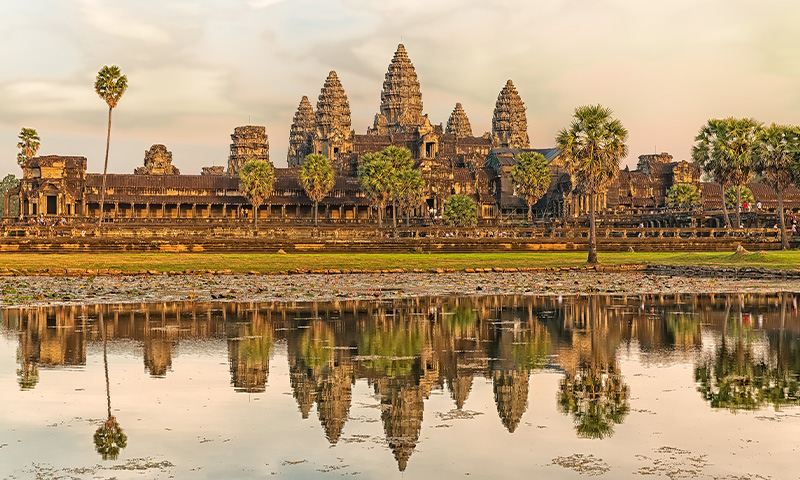
For many Indian travellers raised on stories of Vishnu, Shiva, and the Ramayana, standing before Angkor Wat feels oddly familiar. The towers rising above the Cambodian jungle, the carved panels of churning oceans, the gods and demons locked in battle, all of it belongs to a shared cultural memory that stretches back more than a thousand years.
Angkor Wat is often called a temple complex, a UNESCO site, or the largest religious monument in the world. For an Indian spiritual traveller, it is also something more personal. It is proof that Sanatan Dharma once travelled across oceans and found a home in Southeast Asia, where it still breathes through stone, ritual, and local tradition.
This guide walks you through what to expect, how to plan, and why this trip belongs on your spiritual travel list.
Why Angkor Wat Matters to Indian Spiritual Travellers
Angkor Wat was built in the early 12th century by Khmer king Suryavarman II as a temple dedicated to Lord Vishnu. Unlike most Khmer temples that face east, Angkor Wat faces west, a direction linked to Vishnu and the setting sun. Scholars believe the orientation also reflects its role as a funerary temple for the king.
What makes it extraordinary for Indian visitors is how directly it speaks to familiar stories. The outer gallery carries one of the longest continuous bas-reliefs in the world, with scenes from the Mahabharata, the Ramayana, and the Samudra Manthan. You see Krishna lifting Govardhan, Rama fighting Ravana, and devas and asuras pulling Vasuki the serpent to churn the ocean of milk.
For a traveller who has grown up reciting these stories, walking the galleries feels less like sightseeing and more like reading a familiar text in a new script.
The Hindu Roots of Angkor Wat
The Khmer Empire absorbed Indian religious and artistic traditions over several centuries, carried east by traders, scholars, and priests. Sanskrit inscriptions, Shiva lingas, and Brahmanical rituals became part of royal life. Angkor Wat emerged as the architectural peak of this exchange.
Vishnu at the Centre
The central sanctuary originally housed an image of Vishnu. Though the temple later shifted to Theravada Buddhist use, Vishnu imagery remains across the complex. A standing Vishnu statue, believed to be the original deity, still receives offerings from devotees at the western entrance.
The Cosmic Blueprint
The layout mirrors Hindu cosmology. The central tower represents Mount Meru, the mythical home of the gods. The surrounding towers stand for the lesser peaks, and the moat represents the cosmic ocean. For visitors familiar with Hindu temple architecture in India, especially South Indian styles, the parallels are immediate.
If temple architecture interests you, a journey like the Lucknow Ayodhya Prayagraj Varanasi tour package from Traveloi traces similar design and devotional traditions across North India and can make for a meaningful follow up after Cambodia.
Planning Your Visit from India
Angkor Wat sits near Siem Reap in northwestern Cambodia. Here is what Indian travellers should know before booking.
Best Time to Visit
The dry season, from November to March, brings cooler mornings and clear skies. This is also peak tourist season. April and May can be very hot. The monsoon months from June to October bring lush greenery and smaller crowds, though afternoon rain is common.
For sunrise photography at the main temple, the clearest months are usually December and January.
How to Reach
Most Indian travellers fly into Siem Reap Angkor International Airport, which handles connections through Bangkok, Singapore, and Kuala Lumpur. Direct flights from India are limited, so a one-stop route is standard. Phnom Penh is another entry point, roughly five to six hours by road from Siem Reap.
Visa for Indian Passport Holders
Indian citizens can apply for a Cambodian e-visa online before travel. It is usually processed within three business days. A visa on arrival is also available at major airports and land crossings, but the e-visa route is often smoother.
Duration
A focused Angkor visit works well in three to four days. If you want to extend into Phnom Penh, the Mekong, or spiritual sites outside the Angkor circuit, plan six to eight days.
Inside Angkor Wat: What to See
The complex is vast, so a planned route helps.
- Sunrise at the Reflection Pool. The classic image of Angkor Wat mirrored in water happens here. Arrive by 5 am.
- The Bas-Relief Galleries. Walk the outer walls in a counter-clockwise direction, which is the traditional funerary direction. The Churning of the Ocean of Milk panel runs for nearly fifty metres.
- The Central Sanctuary. Climb the steep stairs to the upper level, which once represented the summit of Mount Meru. Dress modestly, since this remains an active religious space.
- The Vishnu Shrine. Located at the western entrance, this is where you can offer flowers or incense.
Hire a licensed Khmer guide. The stories carved into the walls are layered, and a good guide can connect the panels to specific Puranic references you may already know.
Beyond Angkor Wat: Other Sacred Sites in Siem Reap
Angkor Wat is the headline, but the wider Angkor Archaeological Park holds dozens of temples worth exploring.
- Bayon. Famous for its enormous stone faces, likely a blend of Avalokiteshvara and the king himself.
- Ta Prohm. The jungle temple left partially unrestored, with silk cotton tree roots wrapping the stones.
- Banteay Srei. A tenth century temple with some of the finest Hindu carvings in the region, including scenes of Shiva and Parvati.
- Phnom Kulen. The sacred mountain where the Khmer Empire was founded, home to the River of a Thousand Lingas carved into the riverbed.
Phnom Kulen is especially meaningful for devotees of Shiva. Water flowing over the lingas is considered sanctified and is still used in local rituals.
For Indian travellers who connect deeply with sacred mountain pilgrimages, this experience echoes the Muktinath tour package in Nepal, where a sacred shrine and flowing water form the heart of the pilgrimage.
Practical Tips for Indian Travellers
- Currency. US dollars are accepted almost everywhere. Carry small notes.
- Language. Khmer is the official language. English works at hotels and major sites. A few Hindi speakers can be found at Indian restaurants in Siem Reap.
- Dress code. Shoulders and knees must be covered inside temple grounds. Carry a light shawl.
- Hydration. The heat is intense. Carry a refillable bottle and electrolyte sachets.
- Respect active worship. Many temples still receive daily offerings. Lower your voice and avoid stepping on thresholds.
Food, Stay, and Cultural Etiquette
Siem Reap has a strong vegetarian and Jain-friendly dining scene thanks to its popularity with Indian pilgrims. Several restaurants serve pure veg Indian thalis, South Indian breakfast, and Jain meals on request. Khmer vegetarian dishes such as num banh chok with vegetable broth and amok tofu are worth trying.
Accommodation ranges from budget guesthouses near Pub Street to boutique heritage hotels and wellness resorts. For a spiritually focused stay, consider small properties outside the town centre with gardens and quieter mornings.
Local etiquette is gentle but important. Remove shoes before entering shrines. Do not touch monks, especially if you are a woman. Photographs of praying devotees should be taken only with permission.
Planning the Trip with a Trusted Partner
Cambodia is not currently on the standard Traveloi destination list, but a seasoned Indian spiritual travel partner can still help shape the trip. For a nearby Buddhist and heritage context that pairs well with Cambodia, the 5 Days Sri Lanka tour package is a useful parallel and shows how curated Southeast Asian spiritual travel is approached.
Frequently Asked Questions
Q1. Is Angkor Wat still a Hindu temple?
Angkor Wat was built as a Vishnu temple in the 12th century and later shifted to Theravada Buddhist use. It functions today as an active Buddhist site, though Hindu imagery, iconography, and the original Vishnu shrine remain central to its character.
Q2. Do I need a visa to visit Cambodia from India?
Yes. Indian passport holders need either an e-visa, which can be applied for online, or a visa on arrival at major airports. The e-visa is typically processed within a few business days.
Q3. What is the best time of year to visit Angkor Wat for Indian travellers?
November to March offers the most comfortable weather and the clearest sunrises. December and January are peak months, so book flights and hotels in advance.
Q4. How many days do I need for Angkor Wat?
A focused visit works well in three to four days. This covers Angkor Wat itself, Bayon, Ta Prohm, Banteay Srei, and Phnom Kulen with time to rest between temple days.
Q5. Is Angkor Wat safe for solo Indian travellers and families?
Siem Reap is generally considered safe for Indian solo travellers and families. Standard precautions apply, such as using licensed guides, booking reputable accommodation, and keeping valuables secure.
Q6. Can I find vegetarian or Jain food in Siem Reap?
Yes. Siem Reap has multiple Indian restaurants serving pure vegetarian and Jain meals. Many Khmer dishes can also be adapted on request.
Q7. Does Traveloi offer Cambodia tours?
Cambodia is not currently on the standard Traveloi destination list. The team can, however, advise on spiritual travel planning and connect your interest to related offerings in Nepal, Bhutan, Sri Lanka, and India.