
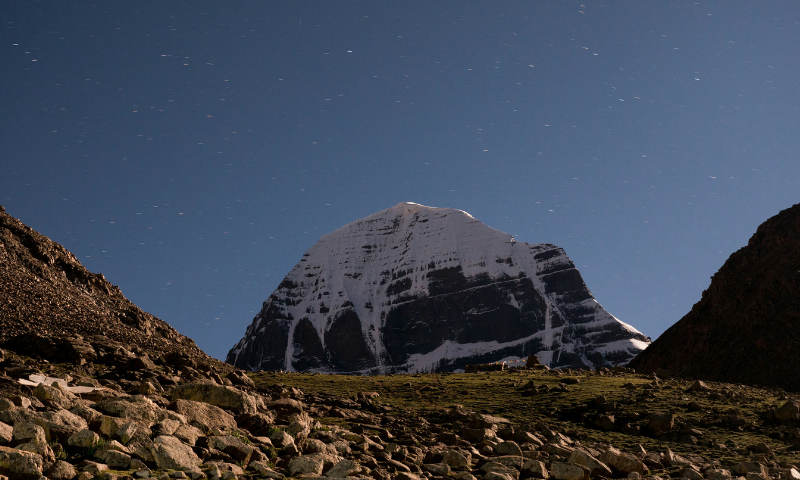
Not everyone has the privilege to go to Tibet. But for those who are looking for the divine energy of the Kailash mountain within India’s border, there is an answer buried in the high reaches of the Kumaon Himalayas. Adi Kailash, or Chota Kailash, is located near the Indo-Tibetan border in Dharchula, Uttarakhand. At 6,310 metres above sea level, it is revered by Hindus, Jains, and Buddhists as the earthly counterpart of the sacred Mount Kailash in Tibet.
This is not a place for casual sightseeing. It is a pilgrimage route, which passes through remote villages, alpine meadows, and roaring Himalayan rivers before reaching one of the most spiritually charged landscapes in the country. And in recent years, with better access by road, facilitated by the Border Roads Organisation, it has become much more accessible than most people assume.
Why Adi Kailash Holds Sacred Significance
The name itself tells you something. “Adi” means primordial or original in Sanskrit, and as per tradition, this mountain is one of the oldest ones associated with Lord Shiva and Goddess Parvati. It is thought to be their divine abode, which resembles the sacred symbolism of Mount Kailash across the border.
Two sacred water bodies are located near Adi Kailash: Parvati Sarovar and Gauri Kund. Both have a profound religious significance. Pilgrims conduct rituals, offer prayers, and meditate at such places. The silence of the water amid the snow-capped mountains creates a setting that those who make the pilgrimage describe as being unlike anything else on the pilgrimage circuit.
For people who cannot undertake the Kailash Mansarovar Yatra in Tibet because of health, visa, or age constraints and for cost reasons, Adi Kailash is a spiritually fulfilling alternative that lies completely within India.
Adi Kailash vs Kailash Mansarovar: A Practical Comparison
| Feature | Adi Kailash | Kailash Mansarovar |
| Location | Dharchula, Uttarakhand, India | Tibet, China |
| Altitude | 6,310 metres | 6,638 metres |
| Travel Requirements | Inner Line Permit (ILP) | Chinese visa + special permits |
| Physical Demand | Moderate | High |
| Accessibility | Mostly by road with short treks | Requires long, high-altitude trekking |
| Duration | 9 to 12 days typically | 2 to 3 weeks |
| Best For | Families, seniors, first-time pilgrims | Experienced trekkers |
For those who are planning their first pilgrimage to the Himalayas, or those who would rather choose a route that does not require extreme physical fitness, the Adi Kailash yatra stands on its own as a complete and deeply meaningful experience. For more extensive options of the Kailash Mansarovar Yatra, Traveloi covers both routes.
Om Parvat: The Mountain That Carries the Divine Symbol
No description of this yatra is complete without Om Parvat. Located in the Pithoragarh district of the state of Uttarakhand, this climactic peak has a natural snow formation on its surface shape which resembles the sacred Hindu symbol ॐ (Om). The formation can be seen from a vantage point near the India-Nepal border, called Nabhidhang.
Pilgrims narrate the experience of seeing Om Parvat as one of the most powerful experiences of the entire journey. The sight is regarded as auspicious, and large numbers of devotees come to see it specifically. Unlike human-made religious markers, the “Om” here is carved entirely by nature and snow, which is what makes it so striking to both believers and non-believers alike.
Together, Adi Kailash and Om Parvat mark the spiritual centre of this yatra. They are rarely visited in isolation, and the route is designed to cover both.
Key Stops Along the Route
The journey through the sacred mountains of Uttarakhand is made up of several amazing stops. Here is what pilgrims usually pass through:
- Dharchula: The starting point for the restricted area leg. Situated on the banks of the Kali River on the Indo-Nepal border, it is here that the Inner Line Permits are arranged before the journey continues.
- Gunji and Kuti Villages: These remote settlements have the Rung and the Bhutia communities. Stone-built homes, simple food, and warm local hospitality make them memorable cultural stopovers.
- Kali River Valley: The route is parallel to the Kali River that forms the boundary between India and Nepal. The scenery through this valley, with its thick wood and high mountains, is striking enough in itself.
- Nabhidhang: This is the point of view from which Om Parvat can be clearly seen. Most groups spend time here in prayer and contemplation.
- Jolingkong: The high-altitude plain close to Adi Kailash, where pilgrims go for darshan and go to the sacred lakes.
Best Time to Plan Adi Kailash Yatra
| Season | Months | What to Expect |
| Spring | May to June | Pleasant weather, blooming meadows, and clear skies. Ideal for first-time travellers. |
| Monsoon | July to August | Lush landscapes but risky conditions. Landslides and slippery terrain make travel unsuitable. |
| Autumn | September to October | Crisp air, excellent mountain views, and vibrant autumn colours. Highly recommended. |
| Winter | November to April | Routes are snow-blocked, and travel is generally not possible. |
The best time for the Adi Kailash yatra is between May and October, specifically avoiding the monsoon months of July and August. September and October are especially popular for the clarity of mountain views as well as the pleasant walking conditions.
Permits: What You Need to Know
Since the region is near the Indo-Tibet and Indo-Nepal border, an Inner Line Permit (ILP) is compulsory. It is issued by the Sub-Divisional Magistrate (SDM) at Dharchula and Pithoragarh.
To get the ILP, you will need:
- A valid government-issued photo ID
- A passport-sized photograph
- A medical fitness certificate
- A notarized affidavit
- Proof of Indian nationality ( for Indian citizens)
Foreign nationals can take part in the yatra, but would need special clearances and submission of their passport and visa details, along with their ILP application. Without valid permits, travel beyond Dharchula is not allowed.
It is made much easier if you book an organised Adi Kailash tour package, where the tour operator takes care of all the paperwork and the formalities for permits on your behalf.
Planning Your Adi Kailash Tour Package: What to Look For
The yatra lasts for about 9 to 12 days and begins from Kathgodam or Haldwani. What you carry is just as important as how you plan:
Packing essentials:
- Warm layered clothing: thermals, woolens, and a windproof jacket
- Rugged trekking shoes with ankle support
- Rain clothes, sunglasses, gloves, and a sun hat
- Personal drugs and altitude sickness tablets
- Reusable water bottle, power bank, and a torch
- All permit documents and identity proof in a waterproof pouch
- Dry fruits and energy bars for high altitude stretches
Accommodation along the route consists of government guesthouses, homestays, and basic lodges in Gunji and Kuti. Facilities are modest, but the hospitality is the real thing. Food is freshly prepared, vegetarian, and reflects local Himalayan cooking. Carry packaged food for the intervals between settlements.
Traveloi has planned itineraries specially for this yatra which include acclimatisation days, experienced guides, and special support for senior pilgrims. The team also provides packing checklists, takes care of all permits, and has flexible itinerary options for those who have time constraints.
If you are looking at all the spiritual things that Uttarakhand has to offer, a combination of this yatra with the Chardham circuit or the cave temple at Patal Bhuvaneshwar makes for a well-rounded Himalayan pilgrimage.
Frequently Asked Questions
Q1. What is Adi Kailash and why is it called the Kailash mountain in India?
Adi Kailash is a 6,310 metre high mountain range in the Dharchula region of Uttarakhand, near the Indo-Tibetan border. It is known as the Kailash mountain in India since it is believed to be the sacred replica of Mount Kailash in Tibet that is worshipped as the abode of Lord Shiva and the Goddess Parvati. The prefix “Adi” means primordial, as it reflects its ancient religious significance. It is also commonly known as Chota Kailash.
Q2. How long does the Adi Kailash yatra take, and where does it start?
The yatra usually lasts for 9 to 12 days, depending on the itinerary that is taken. Most of the journeys start from Kathgodam or Haldwani in Uttarakhand and then continue by road via Pithoragarh and Dharchula. After completing permit formalities at Dharchula, pilgrims go through Gunji, Kuti, Nabhidhang, Jolingkong, to Adi Kailash and Om Parvat.
Q3. Which is the best time for Adi Kailash and Om Parvat yatra?
The best time for the Adi Kailash yatra is May to June and September to October. May and June are pleasant weather months, and when the alpine meadows are blooming, while September and October provide clear skies and great mountain visibility. The monsoon months of July and August are usually avoided because of the danger of landslides and slippery mountain roads.
Q4. Is the Adi Kailash Om Parvat yatra suitable for elderly and less physically active pilgrims?
Yes, it is considered suitable for old pilgrims and those with good moderate fitness standards. Thanks to the better road connectivity that was provided by Border Roads Organisation, most of the way can be covered by vehicle. Short walks and treks are necessary in holy places such as Parvati Sarovar and Nabhidhang, which are manageable if done with proper acclimatisation and preparation. Consultation with a doctor is highly recommended for elderly travellers before setting off on the journey.
Q5. Do I need a permit for the Adi Kailash yatra, and how do I get one?
Yes, an Inner Line Permit (ILP) is mandatory as the region is close to the India-Tibet and India-Nepal border. The permit is provided by the Sub-Divisional Magistrate at Dharchula and Pithoragarh. Required documents include a valid photo ID, a recent photograph, a medical certificate, and a notarized affidavit. Booking through an organised Adi Kailash tour package, your tour operator will manage all the formalities related to the permit on your behalf, and thus, there will be no administrative burden on the pilgrim.
Q6. Which makes Om Parvat different from other Himalayan peaks?
Om Parvat is special because of a natural formation of snow on its surface in the shape of the sacred Hindu symbol ॐ (Om). This formation is visible from Nabhidhang, near the border of India and Nepal, and is in no way man-made. The natural symbol found on top of a mountain high up in the Himalayas is a symbol of God to pilgrims and attracts devotees who want to see it as a part of the larger Adi Kailash yatra.