
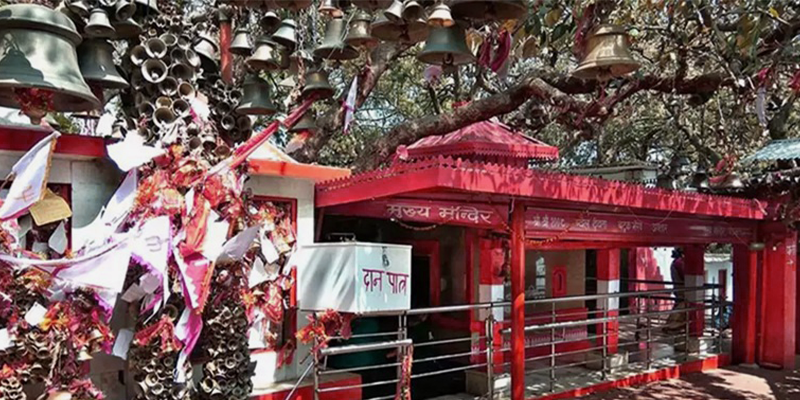
Walk into the Chitai Golu Devta Temple for the first time, and you will notice something you have never seen before at any other temple in India. Bells. Thousands of them. Big ones, small ones, ornate ones, and simple ones. They hang from every available surface, every beam, every tree in the temple complex. Alongside the bells, you will see stacks of handwritten letters, some sealed, some open, some stamped like official applications.
This is not a place where devotees come to light a lamp and leave. This is where people bring their disputes, their unresolved cases, and their appeals for justice to a deity who, for centuries, has been believed to deliver it.
Located about 8 kilometres from Almora in Uttarakhand’s Kumaon region, the Chitai Golu Devta Temple is one of the most culturally distinctive spiritual sites in North India. It holds a place in the Kumaoni heart that very few temples anywhere do. Understanding why requires going beyond the bells and the letters, and into the story of Golu Devta himself.
Who Is Golu Devta?
Golu Devta, also known as Goljyu or Gwell, is revered across the Kumaon region as the god of justice. In local tradition, he is believed to be an incarnation of Lord Shiva, worshipped specifically in his role as the righter of wrongs. Folk accounts describe him as a warrior prince associated with the ancient Katyuri dynasty that once ruled parts of the Kumaon Himalayas.
The stories about Golu Devta are many and vary slightly across villages. What remains consistent across all of them is the core theme: he, as the deity, turns human when the system fails.
When a dispute cannot be resolved, when a wrong incident cannot be corrected through courts or village councils, when justice feels out of reach, Kumaoni tradition says you write it down, tie it at his temple, and let Golu Devta handle it.
This is not a niche folk belief. It is mainstream across the Kumaon region. You will find Golu Devta temples in several locations, including Ghorakhal and Champawat. Still, the Chitai temple near Almora is considered the most powerful and is by far the most visited.
The Tradition of Bells and Letters
What makes the Chitai Golu Devta Temple so visually arresting is the bell tradition. Devotees whose prayers have been answered return to the temple to hang a bell as a gesture of gratitude. Over decades and generations, this practice has resulted in an enormous accumulation. There is no precise count, but the bells are believed to number in the hundreds of thousands, with new ones being added regularly.
The letters are even more striking. Devotees write their grievances, their prayers, and their appeals on paper, sometimes on standard letter sheets, sometimes on stamp paper made out to look like a court petition. These are tied to the temple walls, fences, trees, and any surface where the writer can secure them. The content ranges from property disputes to family matters, from health concerns to professional troubles.
The atmosphere at the temple is a genuinely unusual mix. It is peaceful in the way any hill temple is peaceful, but there is also an undercurrent of intensity that comes from knowing each of those letters represents someone’s unresolved struggle. You are standing in what is, in a very literal sense, a physical record of Kumaoni faith.
The Legend Behind the Temple
Local tradition traces Golu Devta back to a royal lineage. One widely told story describes him as the son of a Katyuri king, born under unusual circumstances and later caught up in a series of injustices that led to his death. After his death, he is believed to have returned to the region as a divine figure, tasked specifically with ensuring that no one who approached him sincerely would be denied justice.
The Chitai Golu Devta Temple was established centuries ago at the site where, according to local accounts, he appeared to his devotees and asked for a temple to be built. The current temple structure is relatively modest in scale compared to the grand Himalayan temples of the region. It does not rely on architectural grandeur. Its significance comes entirely from the tradition it carries forward.
Unlike many temples across India that are built around a grand central idol or imposing architecture, Chitai Temple’s power comes from what devotees have brought to it over centuries. That, in itself, is worth seeing.
Why the Chitai Temple Deserves a Spot in Your Uttarakhand Itinerary
Most travellers to Uttarakhand focus on the Char Dham circuit (Yamunotri, Gangotri, Kedarnath, Badrinath) or popular hill stations like Nainital, Mussoorie, and Rishikesh. The Kumaon region, while beloved by seasoned travellers, is often under-explored by first-time visitors.
The Chitai Golu Devta Temple is a strong reason to change that. Here is why it belongs in your Uttarakhand tour packages:
- It offers a cultural experience you will not find elsewhere. The bell and letter tradition is genuinely unique. No other temple in India operates in quite the same way.
- It pairs naturally with Almora and nearby sites. Almora itself is a beautiful hill town with colonial-era bazaars, old temples, and sweeping views of the Himalayan peaks. Kasar Devi, Jageshwar Dham, and Binsar are all within comfortable reach.
- It carries deep spiritual weight without being crowded in the way Char Dham sites can be. The Chitai temple is busy, especially on weekends and festivals, but the energy is grounded rather than overwhelming.
- It suits travellers across life stages and interests. Families, seniors, and younger travellers all find something meaningful here. The temple is accessible, easy to reach, and does not require physical strain.
If you are planning a broader Uttarakhand trip that includes the Char Dham pilgrimage, adding a Kumaon segment with Chitai at its centre gives your journey a dimension that the main Char Dham circuit does not cover. Traveloi’s range of Uttarakhand tour packages includes itineraries that can be extended into the Kumaon region on request.
How to Reach Chitai Golu Devta Temple
Chitai is well-connected by road, and reaching it is straightforward once you are in Uttarakhand.
- By Road from Almora: The temple is about 8 kilometres from Almora town. Shared taxis, private cabs, and local buses are easily available. The drive takes roughly 20 to 25 minutes along a scenic mountain road.
- By Road from Kathgodam: Kathgodam is the nearest major railhead and a common entry point to Kumaon. The drive from Kathgodam to Chitai takes approximately 3 to 4 hours, depending on road conditions.
- By Road from Delhi: Delhi to Almora is a 9 to 10-hour drive. Most travellers break this into two legs with an overnight halt in Nainital or Bhimtal.
- By Air: The nearest airport is Pantnagar, which is roughly 4 hours by road from Almora. Dehradun airport is another option for travellers starting from the Garhwal side.
- By Rail: Kathgodam railway station is the closest and is well-connected to major cities, including Delhi, Lucknow, and Dehradun.
Traveloi’s team handles ground transport as part of its Uttarakhand itineraries, which removes the logistical hassle of coordinating taxis and drivers across multiple days in the hills. If you want a broader spiritual circuit, their Chardham Yatra packages can be extended with Kumaon additions like Chitai, Jageshwar, and Kasar Devi.
Best Time to Visit Chitai Golu Devta Temple
The temple is open year-round, but the experience varies significantly by season.
- March to June: This is the most pleasant time to visit. The weather is mild, the skies are clear, and the surrounding hills are lush. Ideal for travellers combining the temple visit with exploration of Almora and nearby sites like Binsar.
- July to September: The monsoon season brings rain to the Kumaon hills. Roads can be slippery, and landslides occasionally affect travel in the region. The temple remains accessible, but planning needs more flexibility.
- October to November: The post-monsoon window is arguably the best time. Skies are crisp, visibility of the Himalayan peaks from nearby viewpoints is excellent, and the temperatures are cool but comfortable.
- December to February: Winters are cold, and snowfall is possible at higher altitudes nearby. The temple is less crowded during this period, which appeals to travellers who prefer a quieter experience. Warm clothing is essential.
If your goal is to visit Chitai as part of a larger Uttarakhand spiritual tour, the March to June and October to November windows align well with the Char Dham season (May to October), making it easier to combine both in a single trip.
What to Expect When You Visit
A visit to Chitai Golu Devta Temple is simple in terms of logistics, but rich in atmosphere. Here is what a typical visit looks like.
You approach the temple along a narrow road lined with small shops selling bells, flowers, incense sticks, and letter-writing supplies. Bells are available in a wide range of sizes, from tiny hand-sized ones to large heavy ones. Most devotees buy a bell, a garland, and a sheet of paper or stamp paper for their letter.
Inside the temple complex, you will see the main shrine with the idol of Golu Devta. Devotees bow, offer prayers, and then write their letters. Some write in Hindi, some in English, some in Kumaoni. The letters often follow the format of a formal application, addressed to Golu Devta himself, explaining the situation and requesting his intervention.
After writing, the letter is tied somewhere on the temple premises, often alongside a bell. Devotees whose prayers are fulfilled are expected to return, acknowledge the answered prayer, and hang another bell in gratitude. This cycle is what has produced the visual spectacle you see today.
The entire visit typically takes 45 minutes to an hour, unless you are attending a special puja or festival event.
Combining Chitai With Other Kumaon Highlights
The Kumaon region has a lot more to offer beyond the Chitai temple, and a smart itinerary takes advantage of the proximity. Consider pairing your Chitai visit with:
- Jageshwar Dham: Roughly 40 kilometres from Almora, this ancient temple complex has over a hundred stone temples dedicated to Lord Shiva. It is one of the most historically significant temple sites in North India.
- Kasar Devi: About 8 kilometres from Almora, this hilltop temple has been a retreat for spiritual seekers including figures like Swami Vivekananda. The energy and views from here are exceptional.
- Binsar Wildlife Sanctuary: A short drive from Almora, Binsar offers panoramic views of the Himalayan range including peaks like Nanda Devi, Trishul, and Kedarnath.
- Nainital: About 3 hours by road from Almora, Nainital is a popular base for families and couples exploring Kumaon.
- Bhimtal and Sattal: Quieter alternatives to Nainital, ideal for travellers who prefer calmer surroundings.
A well-structured Kumaon itinerary typically spans 5 to 7 days and can be combined with a Garhwal-side pilgrimage like the Char Dham route. For a broader view of spiritual tourism options across India, Traveloi’s Pilgrimage Tours page covers the full range.
Planning Your Visit With Traveloi
Uttarakhand’s spiritual sites reward careful planning. The hills are beautiful but physically demanding. Roads are scenic but can be unpredictable in weather. Accommodation varies widely in quality across the region. Trying to coordinate all of this independently takes time and often results in compromises you could have avoided.
Traveloi has built a strong track record in Uttarakhand travel, with deep local knowledge of both Garhwal and Kumaon. The team handles ground transport, accommodation, meals, and local support, so you can focus on the experience rather than the logistics. Whether you are planning a focused Kumaon trip centred on Chitai and Jageshwar, or a broader spiritual tour that combines the Chardham tour package with Kumaon extensions, Traveloi’s consultative approach helps shape the itinerary around your interests.
You can explore the full range of options on the Traveloi Uttarakhand destination page or reach out via the Contact page to discuss custom itineraries.
For travellers also interested in related pilgrimage journeys, the Adi Kailash Om Parvat Yatra and Kailash Mansarovar Yatra are worth reviewing. Both take you through other parts of the Himalayan region and can be paired with a Kumaon segment for a comprehensive spiritual circuit.
Frequently Asked Questions
Q1: What is the significance of Chitai Golu Devta Temple?
Chitai Golu Devta Temple near Almora is dedicated to Golu Devta, revered across the Kumaon region as the god of justice. Devotees visit the temple to write letters detailing their grievances and tie them at the temple, along with hanging bells as offerings. It is considered one of the most culturally distinctive spiritual sites in Uttarakhand.
Q2: Why do devotees tie bells and letters at the Chitai temple?
The tradition is rooted in the belief that Golu Devta delivers justice to those who approach him sincerely. Devotees write their appeals on paper and tie them at the temple. When their prayers are answered, they return to hang a bell as a gesture of gratitude. Over centuries, this practice has created the temple’s iconic appearance.
Q3: How can I include the Chitai Golu Devta Temple in my Uttarakhand tour packages?
Most Uttarakhand itineraries can be extended to include Kumaon region visits. Traveloi offers customizable Uttarakhand tour packages where you can add Chitai, Almora, Jageshwar, and Kasar Devi as part of the broader trip. Discuss your interests and available days with the planning team to shape the right itinerary.
Q4: What is the best time to visit Chitai Golu Devta Temple?
March to June and October to November are the most comfortable periods. The weather is pleasant, roads are clear, and the surrounding areas are easy to explore. Monsoon months (July to September) bring rain and occasional travel disruptions. Winters are cold but offer a quieter temple experience.
Q5: Can I combine a Chardham tour package with a visit to Chitai Temple?
Yes. The Char Dham circuit covers the Garhwal region, while Chitai is in the Kumaon region. A well-planned extended itinerary can cover both sides of Uttarakhand. Your tour operator can structure the trip so you complete the Char Dham pilgrimage first and then move into Kumaon for the Chitai and Almora segment.
Q6: Is Chitai Golu Devta Temple suitable for senior citizens and families? Yes. The temple is easily accessible by road and does not require any physical trekking. The site is senior-friendly, and the short drive from Almora makes it manageable for families with children as well. Basic facilities including washrooms and nearby eateries, are available in the vicinity.
Q7: What should I carry when visiting the temple? Comfortable clothing suited to the season, walking shoes, a light jacket for cooler hours, and cash for offerings and local shopping. Bells, letters, and puja items are readily available at shops near the temple. If you want to write a letter, you can bring one prepared or buy materials on-site.